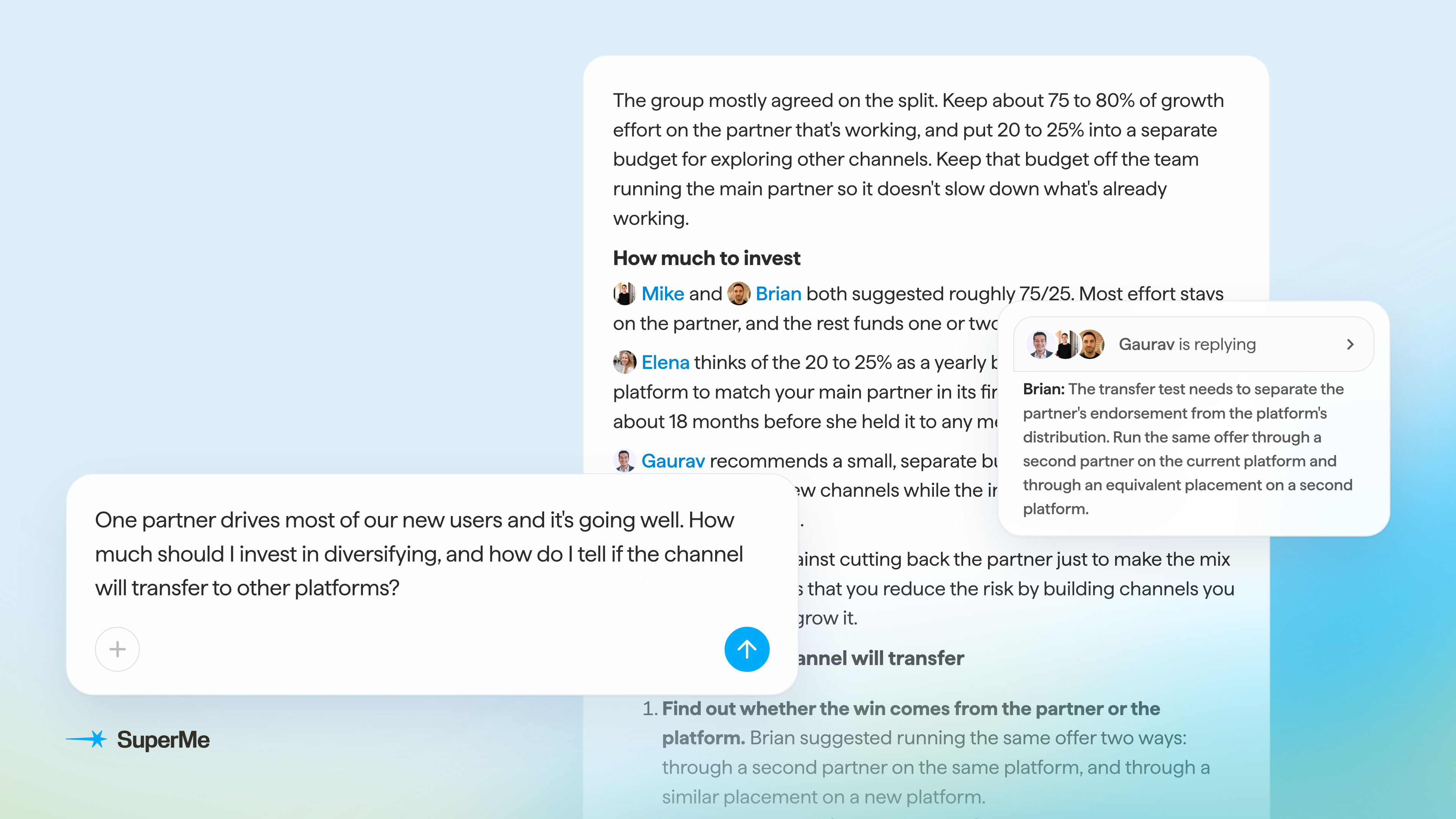
The other day, I was working through a growth challenge with one of our portfolio companies, exploring how they might expand across consumer and enterprise markets. I wanted perspectives from experienced operators who had navigated similar challenges. What followed was a lengthy exchange: specific recommendations, examples of what worked and what didn't, competing ideas, and useful pushback. Some of these experts I barely knew. Others would ordinarily be difficult to reach. And I hadn't taken a minute of anyone's time.
I was using SuperMe, a new kind of network that makes human expertise accessible through AI. It was a compelling example of what we saw in SuperMe early on: the potential to make valuable human expertise accessible in entirely new ways. Today, Forerunner is announcing that we're leading SuperMe's Series A. We believe the company has an opportunity to build a new kind of knowledge network, changing how expertise is discovered, shared, and put to work.
The world's knowledge is bigger than the internet
Search engines organized information, social platforms gave people an audience, and LLMs made vast amounts of published knowledge conversationally accessible. Yet some of the most valuable expertise remains trapped in people's work histories, decisions, mistakes, and accumulated judgment. Much of it never gets published, particularly by accomplished operators who have little interest in becoming creators. Personal networks across careers have always been an imperfect solution. Access depends on whom you know, who makes an introduction, and whether someone has time to help. Social proximity often matters more than the relevance of someone's experience.
"Some of the most valuable expertise remains trapped in people's work histories, decisions, mistakes, and accumulated judgment."
SuperMe approaches this differently. Its AI-powered profiles draw on people's public writing and permissioned private sources, including documents and meeting notes, while giving contributors control over what's shared. When someone asks a question, SuperMe identifies relevant expertise and brings multiple perspectives into the conversation, offering examples, competing recommendations, and thoughtful debate. Users can also assemble their own working groups of experts around specific challenges, shared interests, and ongoing learning.
The result feels different from asking an LLM for advice. You're engaging with perspectives grounded in real experience, including knowledge that may never have been published. And contributors can build recognition through the substance of their work rather than by promoting themselves.
Everyone is becoming a learner
Recently, I was speaking with an accomplished growth executive who had worked at leading technology companies and was now advising ambitious AI startups. Early in our conversation, he leaned toward his camera and admitted that much of his previous experience wasn't translating as clearly as he'd expected. "No priors," he said. I've been hearing versions of that sentiment across the industry.
Intelligence is forcing even the most experienced leaders to reconsider established playbooks. How should companies organize around AI? What does growth look like when software can be created almost instantly? How should products be priced when their economics and capabilities are changing so quickly? Experience remains valuable, but past success is becoming less predictive of what works next. We're all back in the learner's seat.
"As generalized intelligence becomes widely available, contextual judgment becomes increasingly useful."
This challenges the assumption that more capable AI can diminish the value of human expertise. The opposite may be true in important ways. As generalized intelligence becomes widely available, contextual judgment becomes increasingly useful. And that judgment isn't limited to lessons from the past. Some of the most valuable insights are emerging from work underway right now, as people experiment, adapt, and discover what works in a rapidly changing environment. SuperMe has the potential to make that evolving knowledge accessible as it's being developed, rather than waiting for it to be public or become conventional wisdom. Demand for this guidance is growing just as AI makes it possible to share and access it in new ways. That intersection is central to our investment thinking.
Building a new kind of network
At Forerunner, we've long studied how technology shifts change human behavior and create new markets. The mobile era is instructive — its most enduring companies were networks that became more valuable as participation grew. We believe AI is creating a similar opportunity, but with a different foundation.
Historically, networks have organized relationships, audiences, transactions, and content. Intelligence makes it possible to organize something harder to capture: people's accumulated knowledge and judgment. Each contributor can bring a body of experience others can question, learn from, and combine with different perspectives.
"Intelligence makes it possible to organize something harder to capture: people's accumulated knowledge and judgment."
More relevant expertise can produce better answers, attracting more users and substantive questions. As contributors gain recognition and value from participating, more have reason to join. Over time, the network can become increasingly effective at matching specific problems with relevant experience. That's the potential flywheel we see in SuperMe.
As SuperMe scales, it can create new ways to discover expertise and build professional reputations based on what people know rather than how effectively they promote themselves.
A team built for this opportunity
We've known Casey Winters for years through his work advising Forerunner portfolio companies and have seen his judgment in action. His experience at Pinterest, Grubhub, and Eventbrite, where understanding network dynamics was fundamental, is particularly relevant. I also knew of Ludo Antonov through his excellent work at Pinterest and Whatnot. Together, they bring a valuable combination of network expertise, product instincts, and technical capability. They've already put those strengths to work, drawing on their relationships to assemble an early community of exceptional operators from companies including Microsoft, Meta, Shopify, DoorDash, and Reddit, giving SuperMe a strong foundation from which to build its network.
What appeals to us is that Casey and Ludo have started with a tangible problem, helping people get better guidance when facing difficult decisions, while pursuing a much larger ambition. SuperMe has elements of a professional network, knowledge platform, and AI assistant, but none fully captures what it could become.
We're investing in the possibility that AI fundamentally changes how human expertise is accessed and valued. We're pleased to lead SuperMe's Series A and partner with Casey, Ludo, and the team in pursuing that opportunity. If you're building something and working through a difficult question, definitely give SuperMe a try at superme.ai.