The agent market continues to move at a dizzying speed. If 2025 will be remembered as the year consumers started vibe coding, 2026 might be the year agents went mainstream. Remember when we were lining up to buy a Mac Mini earlier this year? Over the past few weeks alone, Notion repositioned (opens in new tab) as the context for every agent, OpenAI launched an agent wallet (opens in new tab) and a new app interface (opens in new tab), and Muse launched an outfit try-on (opens in new tab), an agent email address (opens in new tab), and a commerce integration with Walmart (opens in new tab). And we haven't even seen the agents Apple and Google will surely launch.
After trying dozens of general-purpose (ChatGPT, Instinct, Muse, Town, and Wabi among others) and vertical agents, and meeting with founders building both, our team keeps debating one question: how many agents will each of us have?
With very few, if any, technical moats today, the broad and expanding scope of general-purpose agents feels inevitable. Our conversations have focused on the non-technical factors that could define the boundaries of what's possible: agents earning the right to win, agent collaboration, and most importantly consumer preferences. Where people welcome agents will likely depend on how often they use a product, how much is at stake if it goes wrong, and how many agents a person will be able to manage.
How many categories can one agent win?
Even the best-resourced companies in the world can't buy product-market fit.
Take Amazon. You could hardly escape the Amazon headlines in the second half of the 2010s. The company felt invincible with the successes of AWS, Prime, grocery, and later advertising. The misses are often overlooked, though. Fire Phone, Endless, Wallet, WebPay, TestDrive, and Local were all extensions of the business that didn't work.
AI companies are already expanding beyond their core. OpenAI's acquisitions of Hiro Finance, Torch, and Odessia suggest ambitions to bring finance, health, and travel into ChatGPT. Instinct launched personal finance, Hark launched a credit card, and Muse announced Charm.
We think success comes down to focus, expertise, and having earned the right to win. We also believe that even if the largest companies launch a well-funded and bundled product, specialists can hold their own. Think Slack and Microsoft Teams, Spotify and Apple Music, or Canva, Figma, and Adobe.
An agent has the right to win. How will it build an ecosystem?
General-purpose agents could become a new window to the web, in the same way Google did. Agents will likely have the opportunity to reset the table and go further into the funnel, perhaps most contentiously into checkout. That said, in order for general-purpose agents to maximize their value to consumers, they will need partners that bring supply, expertise, and use flows. And in order for partners to come to the table, agents will need to unlock demand.
Google and Booking.com show one way to think about a successful interdependent relationship. Google is a toll, partner, and competitor for Booking. Google drives demand because it is where many consumers start a travel search. Booking owns checkout, brings supply, and runs a loyalty program consumers value. Each business needs the other. Even though Google launched a Hotels product of its own, its ads business requires restraint to keep the balance.
Early collaboration has come from companies with unique supply or revenue models that agents don't disrupt. Reddit was an early collaborator, striking data-training API deals with Google and OpenAI and more recently limiting crawling agents that are not paying. OpenTable, another early partner to agents and a deeply integrated Google partner, gets paid whether diners arrive directly or through an agent, and it has unique supply because restaurants use a single booking system. Same for Spotify, which recently opened its music library and the personalized data it owns to external agents.
Companies that depend on the transaction or a direct customer relationship, however, have more to lose. United still closes the transaction on its own site, even when the search starts on Google, partly because loyalty and upgrade revenue are hard for a third party to replicate. Same for Amazon needing to keep the discovery and transaction to protect its ad business, though the idea for Prime Plus is catchy.
Who owns what part of the funnel and who captures the value will get sorted over time. The pressure on partners like Booking.com is palpable. Some intermediaries may disappear, and new ones may take their place, but the aggregation and data they provide are valuable to agents. Not to mention the competition among online travel agencies is good for consumers.
An agent has an ecosystem. How will it build a network?
Consumers typically have one personal and one professional email address. Same for phone numbers. These are utilities. If you use Gmail, you can message an AOL address. If you use AT&T, you can call a Verizon number. The publicly funded (email) or governmentally regulated (phone) protocols own the network, not the companies. Gmail reached billions of users without ever owning the network.
Messaging and social media apps have gone the other way. The companies own the networks and the networks are walled, so consumers end up with a handful of apps, often messaging and following the same people on several of them. Each app also gives consumers a reason to be there, whether it's Instagram for photos of the best parts of your life, Reddit for going deep on your interests, WhatsApp for international conversations, Signal for a private conversation, or Snapchat for the unfiltered moments.
We think agent-to-agent interactions between consumers will become one of the most common use cases. Even though there's a growing list of protocols (MCP, A2A, PACT, PAP, etc.), it's unclear if a Muse agent will be able to work with an Instinct agent. We've tried adding agents from different platforms to the same group chat and haven't gotten very far.
The incentives for general-purpose agents to become walled gardens are strong, but history suggests the market will likely shift between openness and control. For example, Facebook opened its platform and social graph to developers, then restricted access when it had over a billion users. Apple went the other way: it limited iTunes to its own devices before expanding to Windows and later launched Apple Music on Android devices, both with an eye toward expanding the market. It's too early to tell where general-purpose agents will settle, and we're not yet convinced of what's better for consumers.
What do consumers want?
Even if companies earn the right to win, interdependent ecosystems develop, and agents can work together, consumers will have a significant say in how many agents they use. This is the part we've built our business around. General-purpose agents will likely take on a significant share of our lives, but just because an agent can do something doesn't mean consumers will want it to. We think about how, after 30 years, e-commerce has not even reached 20% of total retail sales. Where consumers welcome agents will likely depend on frequency and stakes (we had a fun debate with our SuperMe group about this).
Frequency: A product or service that consumers use at least weekly will likely have the right to try to improve until it beats a general-purpose agent. For example, DoorDash saw only hundreds of orders through third-party agents, while it saw a 50% increase in grocery order size from its own in-app agent. It recently launched a texting interface to match the way people prefer to communicate with general-purpose agents.
Stakes: A product or service with a significant downside for getting it wrong will also likely have the right to try to improve until it beats a general-purpose agent. For example, Robinhood launched agentic stock trading that allows consumers to scan the market, review a portfolio, build watchlists, and trade. The company now has over 200,000 accounts where agents are allowed to trade.
A 2x2 of frequency and stakes provides a starting point for where consumers will likely want vertical agents. Low frequency and low stakes are where general-purpose agents have started and will expand from. High frequency is where vertical agents will likely have the strongest wedge.
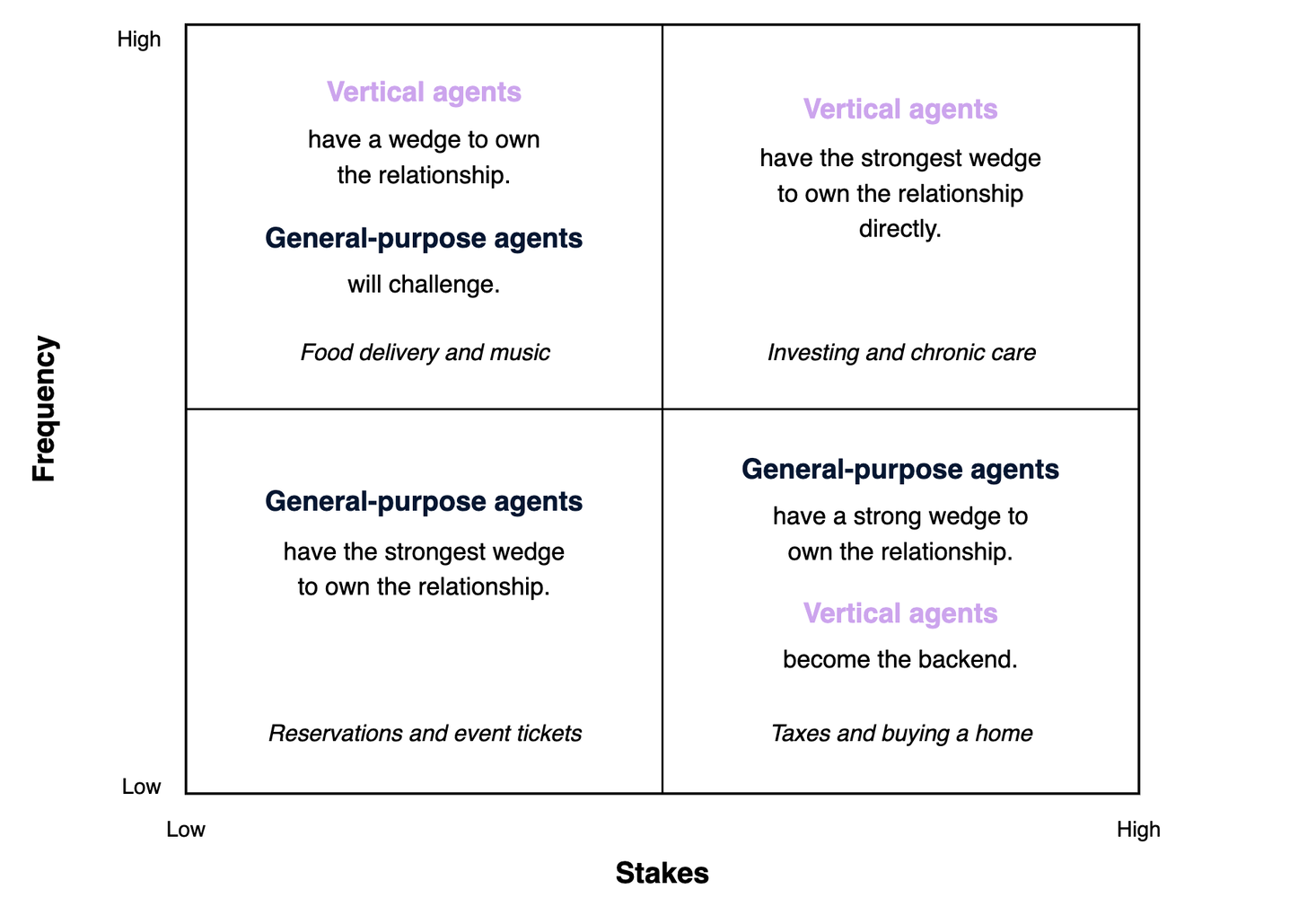
While the 2x2 can be simple and effective, there are a few considerations we're also weighing:
- How much is the experience part of the appeal? Think about Whatnot and live streaming.
- How likely is a consumer to be able to say what they want in one sentence? If there's a significant back and forth, that could create a wedge for a vertical player.
- How much does it matter who keeps the record and who is liable? Think about how Crosby took out an insurance policy for agents.
- How much proof is there today that general-purpose agents can own this? Think about travel accounting for roughly half of GMV on Instinct, and the confirmation by Stripe Link data released last week.
History also suggests consumers could shift preferences even when a general-purpose alternative exists. Google became the default for searching the internet, but Amazon eventually became the starting point for 50%+ of product searches because of its selection, reviews, pricing, and Prime membership.
So how many agents will each of us have? Our bet is that the answer won't be set by what the technology can do, but by how many agent relationships consumers want. Frequency and stakes will likely tell us where vertical players could win, and how the ecosystem and network develop will shape how agents work together. But consumers will draw the line.